
I just returned from two weeks in German-speaking Europe. The trip didn’t have the visceral impact of seeing the Northern Lights or an Egyptian pyramid, but it changed the way I see the world through sundry small details: the fluidity of movement through the region’s cities, the comfort with leaving one’s bike unlocked, the aesthetic complement of alpine villages and the valleys they call home.
Below are some reflections followed by a few curiosities. You’ll notice my perspective shifts often rhyme with: “Europe good, actually.” Because of my pro-America bias, any change favoring Europe is notable.
Europe is unproductive (and that’s ok)
In Switzerland, it’s illegal to work Sundays (with exemptions like hotels, hospitals).
This is unthinkable to the American mind, and a blatant rejection of something I hold sacred: the right to sell one’s own labor. While I dislike the restriction, I grew to appreciate deprioritizing productivity in favor of just, like, hanging out.
One sunny Tuesday morning, I found myself in Spiez, an alpine village overlooking Lake Thun. I watched the locals splashing about with their families and lounging amongst shoreline flowers, and couldn’t help but muse: “they probably have zero agents running right now.”
And you know what? Good for them. The only difference between complacency and contentment, I’ve decided, is that the latter appears earned. The bar is placed arbitrarily: the leisurely lifestyle Americans can finally justify in retirement is readily permissible by default in parts of Europe.
I wanted to understand, though — do local status games not compel wealth-generating action? I asked an Uber driver about this, and he explained an ostensibly common German saying: “look only at your own ass.” I chose to interpret this as something between “comparison is the thief of joy” and “thou shalt not covet thy neighbor.”
Locals truly appeared to be running “Base Human” software, with none of the cultural bloatware we’ve encumbered ourselves with in the States. I’m sure they have their own variety of brainworms and status games, but if they exist, they were kept well-hidden in all my interactions.
It’s easy to forget in San Francisco that the desire to be relentlessly productive is a blend of innate and mimetic factors — the latter of which is like fielding an endless volley. German-speaking Europe, meanwhile, felt like a mimetic DMZ.
The axis of time
While studying a cathedral’s facade in Chur, a 5000-year-old town in Switzerland, I found words for a cognitive shift I often experience in Europe. The “axis” of time expands dramatically, its scope in consciousness held wide by the perpetual presence of our species’ past: ancient Roman ruins, prehistoric burial sites, medieval battlegrounds. It’s impossible to forget that something came before.
I call this the “temporal sublime” (h/t Kant): visceral awareness of time’s vastness both ahead and behind, while one peers out from an indivisible “now.” I’d place it in the same phenomenological neighborhood as the Overview Effect — both evoke feelings of dissolution before an incalculably expansive whole.
Life in the US, on the other hand, feels like a never-ending now. Lacking visible signs of our past permits a narrower time “axis.” Under these conditions, history becomes abstract, even irrelevant. Modern civilization becomes easier to take for granted.
I found myself wondering if history’s omnipresence is to Europe what a maternal embrace is to a child: a comforting provision of identity that subtly risks dependency. When it comes to policy, historical identity is sometimes a constraint: what can be done may not comport with “What We Do.” Action taken by Europe may be sure-footed, but restrained by the warm embrace known as The Past. Meanwhile, America’s unmooredness may be its strength. There’s no yesterday to identify with, and no spiritual progenitor owed fealty — only the desire of today, and the promise of tomorrow.
Shared space
Even in urban areas with intense foot traffic, I never so much as bumped shoulders with someone. Locals seem deeply aware of their surroundings and the intentions of those moving around them, as if an internal route planner is constantly calibrating to the environment. In US cities, pedestrian awareness rarely includes more than what lies immediately ahead.
A related theme: cities in German-speaking Europe will just… leave you alone.
American urban environments are an endless assault on the senses — it just took me seeing the alternative to notice. Most commonly this includes bright, flashy advertisements, screaming: “Hey idiot, buy this pharmaceutical! Hire this lawyer!” My travels saw refreshingly fewer, and far subtler advertisements.
The downside: I felt invisible in German-speaking Europe. In American cities, I regularly make eye contact with those passing me, often mutually acknowledged via nod or brief smile. Initially, I assumed the lack of eye contact implied a lack of curiosity, but after asking a local friend, I was told it’s because eye contact is interpreted as an invitation to chat. Whatever the reason may be, I greatly prefer American norms on this.
A loved place
Occasionally, I meet someone who makes me think “wow this person had a loving childhood.” Turns out it’s possible to feel this about a country. Nearly every house, sidewalk, patch of grass in Switzerland felt uncomplicatedly loved. My conversations with locals suggested the same — they spoke of their country with an air of uncompromising devotion, as one might speak of a spouse or child.
Public systems exemplified this, and led to a real perspective change for me: I never thought the U.S. had efficient public systems (e.g. airports), but I figured surely they’re better than other countries. I was wrong. The services I encountered were clearly a product of love. And yes, the product of well-designed incentives is indistinguishable from that of genuine care… but someone cared enough to design those incentives!
Switzerland deserves the crown
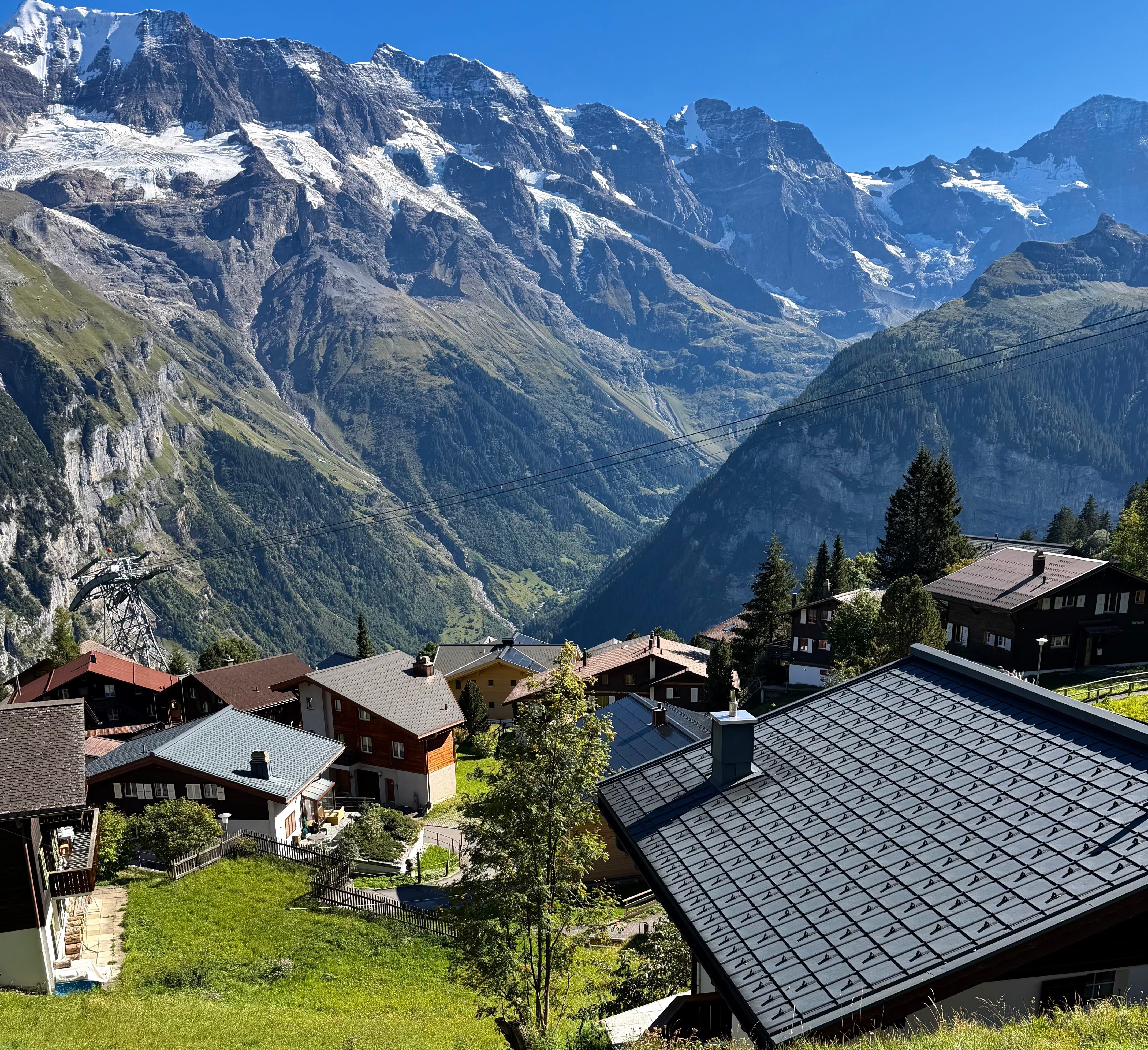
My friend Kyle Qian once remarked that the US “does nature differently” from everyone else. Visiting Switzerland, I see what he meant. In the US, nature and civilization are separate places. Going into nature is like visiting a zoo. In Switzerland, nature and civilization are woven together to form a contiguous, ornate tapestry.
While the Bay Area has the most beautiful terrain on the planet, Switzerland wins overall. They’ve discovered the art of adding beauty to the land they develop. You would be forgiven for thinking the Alps themselves formed for the purpose of cradling Swiss villages. Contrast this with the environment-agnostic, copy+paste approach common in the US… no wonder we’re so hesitant to develop in nature!
Of course, there’s America’s beautiful, walkable exception: the ski town. Sadly, these are closer to Disney villages — destinations engineered to extract money from tourists — than they are real, livable places. A simulacrum of my dear European alpine village.
In praise of homogeneity
I now feel that American culture is thin, but wide and varied; European regional culture is narrow, but deep, consistent and rich — like a sauce left simmering for a thousand years.
I went to a parade including Bavarian organizations that have been active for nearly a millennium. A medieval crossbow club marched by, wearing traditional garb and carrying bows. This obscure-seeming club alone (amongst hundreds in Bavaria) contains a dizzying array of traditions, tournaments, and honors — no doubt a product of centuries of passion.
During my trip, I saw signs of similar social richness everywhere I looked, and found myself pondering Robert Putnam, author of Bowling Alone. Is the dearth of community a uniquely American affliction? If the Europeans have escaped, Putnam would likely argue they benefit from their dense, pre-car urban developments and cultural homogeneity.
In America, diversity is the default. Entering with different values and assumed norms disrupts little, as there’s no stable state to begin with. Switzerland has this stability, and it is worth preserving. Homogeneous, high-context environments obviate the “overhead” otherwise paid by residents in negotiating values and norms. Everything is implicitly understood, enabling a low-friction, more productive day-to-day.
Visiting German-speaking Europe was like running my hand over finely woven silk, after having only felt rough American patchwork. Cultural diversity is absolutely essential in the aggregate, the same way a balanced outfit includes articles of clothing of varying but complementary fabric types. Low-level homogeneity, with high-level diversity, seems to me like the best of both worlds.
Curiosity miscellany
Helvetica (as in, the famous Apple font) is named after the Helvetii, the indigenous people of Switzerland
“CH”: you see this everywhere in Switzerland, including the Swiss TLD (.ch) and currency (CHF). I learned this refers to the country’s official Latin name: Confoederatio Helvetica
Traditional cocaine. There’s fully sanctioned, traditional “cocaine” sold and used throughout Oktoberfest. It’s called Wiesnkoks, and it’s composed of dextrose powder and menthol.
Offline life. The youth don’t seem subject to the “weather of the internet” like their American counterparts. In fact, they seemed downright disconnected. Even on transit, I rarely saw doomscrolling.
Don’t believe the lies. Switzerland isn’t that expensive. At least, the groceries aren’t. American grocers force a “pick two”: healthy, affordable, convenient. Not only did the Swiss find a way around this, they also maintain their low prices regardless of location — even tiny mountain-top villages where they have substantially more pricing power! Once again, incomprehensible to the American mind.
Language laugh theory. I have a pet theory that one can identify a non-English speaker from their laugh alone. During the trip, I noticed German laughs were indistinguishable from those of English speakers, and figured the laugh-style boundary may not divide languages, but language families: Germanic vs. Romance. Then I realized most German speakers also speak English, and… the mystery continues.
Phenomenal writing, I found myself engrossed
Loved all these reflections! Fun fact - the capital of California was formerly called “New Switzerland” (New Helvetia).
We here, too, like the Swiss, have had a cultural sauce simmering for centuries, before Europeans layered on.